
Prostate cancer > Treatment options for prostate cancer that has spread or recurred
Metastatic disease
Once prostate cancer has spread to the lymph nodes and to distant sites, most frequently the bones, it is referred to as metastatic disease (the metastases are the secondary growths that occur at the distant site); in the TNM staging system, this state is known as T3–N1–M1. This is an advanced form of cancer, and one that is associated with a relatively poor outlook, but there is no need to give up hope.
This stage of cancer can still be treated and progression of the disease can be delayed for several years or sometimes longer. The treatment options are:
| Options for metastatic disease |
Orchidectomy Orchidectomy is a surgical procedure in which both the testicles are removed. The reasoning behind this is that, as testosterone is produced in the testicles, their removal stops its production altogether. Most men (more than 80%) respond positively to this treatment, with the progression of their cancer slowing markedly for around 18 months and sometimes much longer.
The operation is straightforward and is performed under a local or general anaesthetic in around 30 minutes. In selected patients, silicone testicular prostheses may be inserted to improve the cosmetic result. The scrotal sac is opened and the testicles are snipped out. You may be allowed out of hospital on the same day, although often your surgeon will want you to stay in overnight to check for bruising. You must take things easy for a week or two, and you should also take regular baths or showers to keep the wound clean. Afterwards, the scrotum will look a little bruised, and later somewhat shrivelled and empty, unless prostheses have been used.
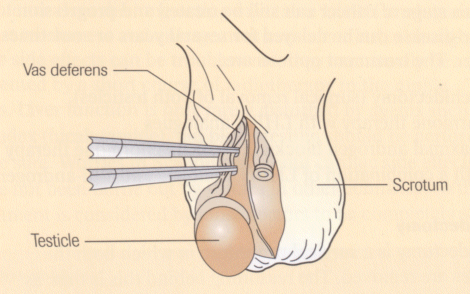 |
| In an orchidectomy, the testicles, which produce testosterone, are removed from the scrotum. |
Although the operation seems rather drastic, and some men are concerned about ‘castration’ and the appearance of their scrotum afterwards, it is a one-off procedure and so avoids the need to take a prolonged course of hormone therapy.
Possible side effects and risks of orchidectomy. As your body will be unable to produce testosterone after the operation, you will lose your sex drive and be unable to achieve an erection. You will also be infertile. These effects are irreversible, so consider the implications fully before consenting to an orchidectomy. Potential complications of the surgery are relatively few, but bruising, blood clots and infections do occur in some men. Hot flushes may result from the hormone changes in your body. You will not become ‘feminised’ or find that your voice changes, but you may notice that you lose some body hair and may have to shave rather less often. There is also often a change in skin texture and a theoretical risk of the brittle bone disorder known as osteoporosis.
Hormone therapy LHRH analogues achieve the same result as removal of the testicles by blocking the production of the male hormone testosterone, and thus reducing the stimulation of cancer growth. LHRH analogues, such as Zoladex (goserelin), are usually administered as an implant, which is injected just under the skin of your abdomen. The procedure is repeated every month or 3 months. As with orchidectomy, a high proportion of men (more than 80%) respond to this treatment and the beneficial effects usually last for around 18-36 months. In terms of effectiveness and safety, there is little to choose between hormone therapy and orchidectomy, but most men prefer the former.
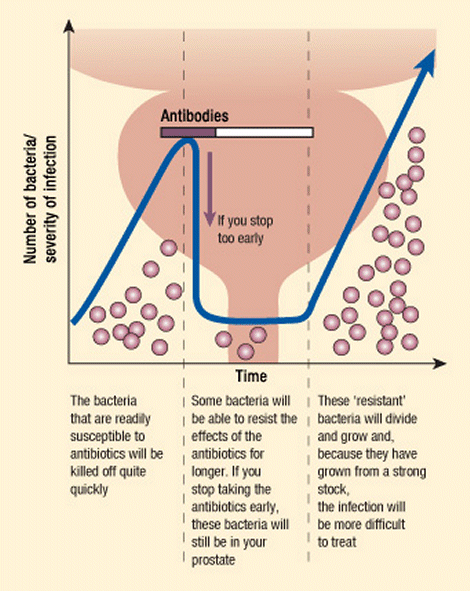 |
| (WRONG DIAGRAM)The effect of hormone therapy on prostate cancer cells and the development of hormone–escaped disease. |
Possible side effects and risks of hormone therapy. At first, the LHRH analogue actually increases testosterone production for a few days. Bone pain may increase as a consequence, and urinary symptoms may worsen. This is known as the ‘flare’ phenomenon. There is even a remote risk of the cancer causing pressure on the spinal cord and, thus, paralysis. To counter these effects, anti-androgens are usually given for 2 weeks before and then for the first 2-6 weeks of LHRH analogue treatment; these effectively block the effect of testosterone on the cancer.
Maximal androgen blockade Maximal androgen blockade combines the use of LHRH analogues with long-term anti-androgens. Whether or not this approach is superior to that using LHRH analogues only or orchidectomy is not entirely clear. Some studies show men respond for a longer length of time with this treatment, while others have failed to show such an effect. Many doctors do have confidence in this approach, though, and feel that it is particularly appropriate for younger, relatively fit men with advanced prostate cancer.
Possible side effects and risks of maximal androgen blockade. As outlined previously, treatment with LHRH analogues results in a loss of sex drive and impotence. Hot flushes can also be a problem but sometimes respond to treatment with Cyprostat (50 mg/day). The other part of the treatment, anti-androgens, may upset your stomach and can sometimes cause diarrhoea.