
Prostate cancer > The future
The prospects for significant progress in prostate cancer in the near future are now better than ever. We can hopefully look forward to effective prevention, earlier diagnosis, better staging, and more effective and less toxic therapy. A number of current research endeavours to improve our understanding of the disease may well translate into improved quality of life and improved survival prospects for those affected by prostate cancer.
Chemoprevention
In the future, it may be possible to prevent prostate cancer. Already there is some evidence that both vitamin E and selenium may have a preventative effect. The benefits of the 5-alpha-reductase inhibitor Avodart (dutasteride) are also currently being assessed in the large REDUCE trial, and several other agents, such as statins which are currently used to lower cholesterol, appear to show promise, but require further research to ensure their safety and effectiveness.
Better diagnosis
Earlier detection, while the disease is still curable, is already a reality as a result of PSA testing. In the future, new tests or variations of existing tests will continue to improve the ability of doctors and surgeons to distinguish early prostate cancer from BPH. Recently, a new test for prostate cancer called the PCA3 (prostate cancer antigen 3) test has been described. It is based on a special genetic analysis of prostate cancer cells present in the urine immediately after a thorough massage of the prostate gland. Preliminary studies suggest that it may be more accurate than the PSA test, but much more research is needed before the true value of this test is known.
It also seems likely that tests will soon be developed that predict the behaviour of individual prostate cancers more accurately, which will make it easier for patients, their family and their doctors to decide which is the best treatment option.
New treatments
Cryotherapy Cryotherapy uses freezing to destroy the prostatic tissue. An ultrasound probe in the rectum enables the position of the prostate to be seen on a computer screen. A number of ‘cryogenic’ probes are then inserted into the prostate, and liquid nitrogen is circulated to reduce the temperature to around -180°C. At this temperature, the tissue surrounding the probes is destroyed. The urethra is protected by circulating warm water through a catheter. Some studies have reported survival rates similar to those achieved with radical prostatectomy, but others have described rectal and urethral damage, which can be difficult to repair. No long-term randomised controlled trials to compare cryotherapy with established treatments have yet been carried out. Currently, it is mainly used as a treatment for prostate cancer that has recurred after radiotherapy, since other treatment options in that situation are limited and the technique does offer the potential of cure. Some surgeons are, however, starting to use it as a primary treatment for patients with locally advanced cancers who wish to avoid radiotherapy.
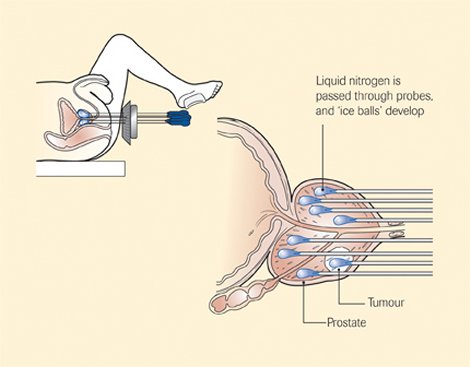 |
| Liquid nitrogen is circulated through the cryogenic probes producing ‘ice balls’, which destroy the prostatic tissue. |
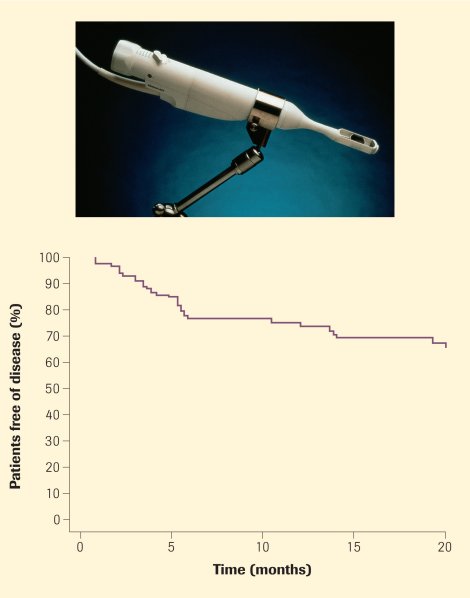
High-intensity focused ultrasound (HIFU) HIFU is a new technology that allows ultrasound waves to be focused on prostate cancer cells. It involves the insertion of an ultrasound probe into the rectum under anaesthesia and then the destruction of cancer cells by ultrasound energy; the treatment can take up to 3 hours. It can be used to treat both newly diagnosed cancers and recurrences after radiotherapy. Initial results look encouraging, since the PSA levels seem to decline and side effects are not prominent, although a catheter is required for several days and sometimes longer after treatment because the prostate swells in response to therapy. Damage to the bladder and rectum have been described as a result of HIFU, so you should seek out a team with extensive experience with this technique if you are considering this as an option. Much longer-term follow-up and trials comparing it with surgery and radiotherapy will be required before HIFU can be regarded as a mainstream treatment, but early results are positive.
Drug treatments As new anti-androgens are developed, it is likely that they will be used at earlier stages of the disease when the cancer cells are more sensitive to the blocking of the action of testosterone.
Research is also being carried out into several drugs that block the pathways of the growth factors that are necessary for the development and progression of prostate cancer. In order for a cancer to grow, it requires a new blood supply. Drugs that block that block the growth of this blood supply have anticancer potential. These so-called angiogenesis inhibitors are currently being tested for activity against prostate cancer. Many of these new approaches offer the possibility of fewer side effects and greater effectiveness.
Immunotherapy Work on harnessing the immune system to counter prostate cancer may eventually make it possible to vaccinate men at high risk of the disease or induce an immune response against established disease.
Gene therapy Spectacular advances in molecular biology have made the prospect of gene therapy an imminent reality. In the not too distant future, it may be possible to ‘turn off’ the oncogenes that induce cancer and ‘turn on’ the protective tumour suppressor genes. New therapies will also be developed that selectively destroy prostate cancer by activating the in-built cell suicide system known as ‘apoptosis’.