
PSA test > Issues surrounding the test
Overdetection of clinically insignificant cancers
As prostate cancer occurs mainly in men beyond middle age, it is perfectly possible that a small cancer might never grow sufficiently large to cause symptoms during a man's lifetime. The anxiety caused by a ‘positive’ (high) PSA result might reduce the man's quality of life by causing unnecessary worry, whereas if he remained ignorant of his condition, his life would be unaffected. However, fears of this sort of over diagnosis of prostate cancer have lessened as doctors increasingly employ ‘active surveillance’ as a treatment strategy for smaller, less aggressive cancers.
False-positive results
An elevated level of PSA in the blood does not necessarily indicate cancer. Indeed, the average PSA level rises with age and any disease of the prostate – particularly BPH, but also prostatitis – can result in an elevated PSA, though usually to a rather minor extent. A high PSA value, or one that increases over time, will usually prompt a doctor to request a biopsy, which involves taking samples of tissue from the prostate. However, scientific studies have shown that when samples of prostate tissue are examined under the microscope, only one man among four with a PSA value between 4 and 10 ng/mL will be found to have cancer (so three will not have cancer even though their PSA levels are raised).
With a higher cut-off (say PSA above 10 ng/mL), the probability that a subsequent biopsy will confirm prostate cancer rises to more than 60%. Of course, the problem with using a higher cut-off to determine who should receive a biopsy is that as the cut-off value increases, so does the ‘false-negative’ rate. (False negatives are PSA test results below the cut-off value, but prostate cancer is present; this is illustrated in the diagram below. Remember that early prostate cancer can be present even when the PSA value is below 4 ng/mL.) Also, if cancer is to be identified at a stage when it is still curable, then it should be detected before the PSA rises much above 10 ng/mL.
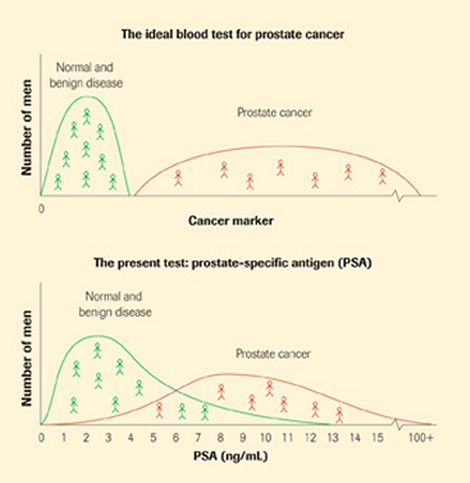 |
| An 'ideal; test for prostate cancer should clearly distinguish men who have cancer from men who do not. Although PSA measurement is a useful test, it is not perfect - if a cut-off of 4ng/ml is used, there is an overlap between patients with BPH or other diseases and those with prostate cancer. Inevitably, this results in some men worrying unnecessarily that they may have cancer. |
Recently there has been great interest in measuring the rate of PSA change over time. Although the information on this subject is only provisional, as already mentioned, it seems that men whose PSA rises by more than 0.75 ng/mL per year are at higher risk of harbouring the more aggressive (so-called ‘tiger’) form of prostate cancer as opposed to a more innocuous ‘pussy-cat’ tumour, which in fact carries little risk of spread. In order to detect the rate of PSA change, regular (usually yearly) blood tests are required. These can usefully be combined with cholesterol and lipid measurements, provided that fasting blood samples are obtained.
Anxiety before the results become available
The speed with which you get your test results depends on where you have your test. It can take anything from a couple of hours to several weeks – obviously those at the longer end of the scale have more opportunity for anxiety. Ask your doctor about the usual waiting time for results in his clinic. However, bear in mind that the most important factor is obtaining an accurate result. Over-the-counter PSA tests, which will allow self-testing, are becoming available in chemist shops. Like the whole PSA issue, these home tests are bound to be rather controversial.
Exposure of those undergoing biopsy to the risk of complications
Biopsy (in which 6–12 small pieces of prostate tissue are removed so that they can be examined for signs of prostate cancer) may result in minor bleeding and the appearance of blood in the semen. This usually settles spontaneously after a few weeks. There is also a small risk of infection, but doctors try to minimize this by prescribing antibiotics for you to take before and for several days after the biopsy. If you have had a biopsy and develop symptoms of infection (especially shaking attacks and a high temperature), contact your doctor immediately.