
BPH > What is Benign Prostatic Hyperplasia ?
Nearly half (around 43%) of men over the age of 65 have either urinary symptoms or a reduced urinary flow due to benign prostatic hyperplasia (BPH). BPH is characterized by the benign (non-cancerous) overgrowth of prostate cells, with the effect that the middle portion of the prostate progressively enlarges. The result is that the part of the urethra that is surrounded by the prostate becomes constricted. This reduces the urinary flow and the man finds that his urine stream becomes weaker and it is more difficult to empty his bladder. These symptoms may significantly impair quality of life.
In response to the increasing obstruction, the bladder’s walls, which are muscular, thicken and become stronger. Consequently, the pressure inside the bladder needed to produce urinary flow has to increase to overcome the effect of the obstruction; this high pressure causes pouches or ‘diverticula’ to form. Less commonly, the raised pressure results in what is known as ‘back pressure’ on the kidneys, causing kidney problems. If BPH is not treated, either chronic urinary retention (characterized by a massively over-distended bladder) or acute urinary retention (the sudden and painful inability to pass any urine) may develop. In either situation, hospital admission, catheterization and eventually prostate surgery are usually required.
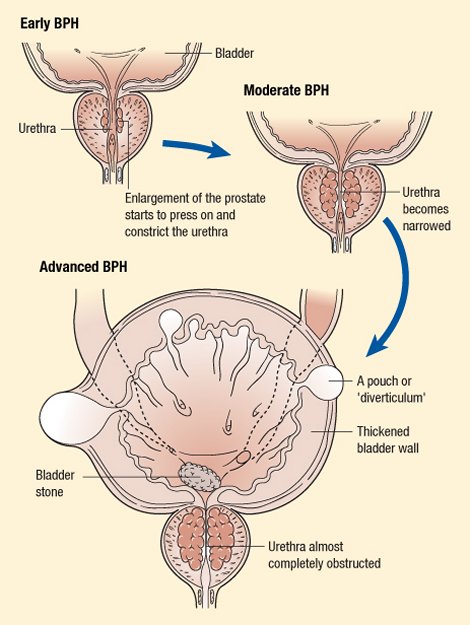 |
| BPH arises as a consequence of excess non-cancerous growth of prostate tissue. The urethra running through the prostate becomes squeezed and the urine flow becomes obstructed. Because the pressure inside the bladder builds up, the bladder walls become thickened and diverticula can form. Bladder stones can also occur as a result of this condition. |
Why do some men suffer more than others?
Recent work has clarified the risk factors linked to an increased likelihood of developing complications of BPH. The larger the prostate (as assessed by digital rectal examination), the greater the risk. Similarly, the risk is increased among those men with a PSA level above 1.4ng/mL. In fact the higher the PSA (provided prostate cancer is not present), the greater the risk of retention. Also more likely to develop complications are men whose urine tends to flow slowly and those who have a relatively large amount of urine left in their bladder after attempting to urinate. Although not all men suffer progressive deterioration, in the majority of cases the symptoms gradually become worse over time and eventually complications develop.
| Why you may be referred to a specialist |